The product
Meet Solvere. Turn it around.
A small set of devices for an older person's home or care-home room. They notice when something is wrong, ask if she's okay in the room she's in, and send a real person when she needs one. No cameras. Nothing to wear. Nothing to charge.
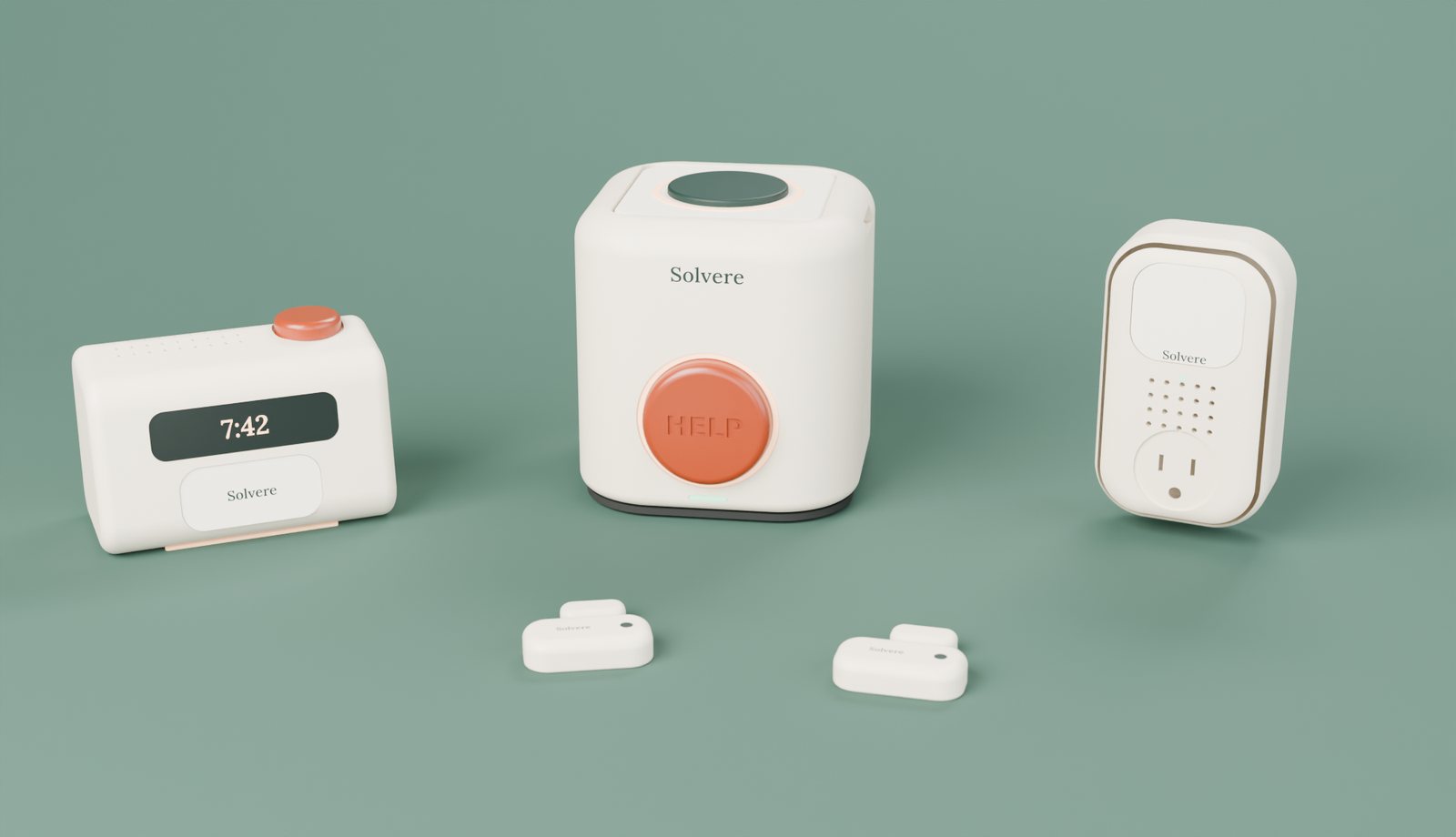
3D needs WebGL. Showing a photo of the kit instead.
Power
Powered by what's already there.
A radar that must never miss a fall is on all the time. Seeed lists 0.5 to 1.4 W for its kit: 12 to 34 Wh a day. Batteries would run flat in days. So every device plugs into a socket the home already has, at the height it already is.
Setup
Four steps. No tools. About 15 minutes.
A son or daughter can do it on a visit, or guide it by video from another city.
The family app
Ask anything. Get answers from what really happened.
What a son or daughter sees. Tap around: it's a working prototype with sample data for "Mom".
Jump to
Try asking: "Did Mom eat today?" or "What was her sugar last night?"
Her side
She never needs a screen. She just talks.
The voice comes from the device in the room she's in. Tap play to hear it. Your browser's voice stands in for ours.
She's in charge
Things she can say
Consent
She agrees in her own words.
At setup the hub explains what it does and asks her. If dementia means she can't decide, her legal proxy (power of attorney or healthcare proxy) does, and it's recorded. She can change what's shared any time.
The safety net
From a fall to a person at the door.
Fixed rules decide every step, not AI. Each step has a clock. If nobody answers, the next step starts on its own.
What 911 receives
- Where
- 12 Maple Ct, Apt 4 · bathroom
- What
- Fall at 2:21 am, no movement, asked twice
- Her notes
- 81 · type 2 diabetes · blood thinner
- Door
- One-time code 4 8 1 9 · valid 30 min
Getting in
The door is locked. She's on the floor.
A smart lock or key lockbox. A one-time code goes only to the person who accepted, lasts 30 minutes, and is logged. She agrees to this at setup.
Talk to her
"Mom, Asha is 4 minutes away."
Family or the responder can speak through the device nearest to her, so she's never alone on the floor wondering if anyone knows.
Care homes
Built for the building, not bolted on.
Assisted living, memory care and nursing homes. In a typical 100-bed nursing home, 100 to 200 falls are reported every year, and half to three-quarters of residents fall (CDC).
Solvere Intelligence
Our own AI. It gets better with every home.
Not a borrowed voice assistant. One agent, built end to end for older adults, from the radar signal to the words she hears.
See it work
Pick a moment. Make the choices.
Watch what the devices notice, what they say, who gets told, and when. Sample home, sample times.
The safety steps follow fixed rules, not AI guesses. AI answers questions and spots slow changes; it never decides whether to send help.
Every problem, solved
We listed everything that could go wrong. Then we engineered an answer.
Each row says honestly where it stands today.
In the prototype: working on this page or in the CAD files, not yet in a home. Engineered: specified from datasheets and codes, next to build. To prove in the pilot: we will measure it in real homes before we claim it.
Why it's different
Other products do one part. Solvere does the whole job.
| What matters | Solvere | Alert pendant | Home cameras | Smart speaker | Smartwatch |
|---|---|---|---|---|---|
| Works if she forgets to wear or charge it | Yes | No | Yes | Yes | No |
| Works in the bathroom and bedroom | Yes, radar sees no faces | If worn | No | Voice only | If worn |
| Asks her, in the room she's in | Yes | No | No | One room | On the wrist |
| Family can ask questions and get real answers | Yes | No | Watch video | No | No |
| Spots slow changes over days | Yes | No | No | No | Some |
| Sends a real person and gets them inside | Yes | Calls a center | No | No | No |
| Fits care-home nurse call and staff phones | Yes | Some | No | No | No |
What's real today
- 3D designs for every device (hub, bath pod, bedside pod, ceiling pod, tags), built around real parts: Seeed MR60 radar (25 × 31.5 mm), Home Assistant Voice PE (84 × 84 × 21 mm), a standard US plug (NEMA 5-15).
- Radar windows 1.47 mm thick with a 2.5 mm air gap, from Seeed's own radome formula.
- Printable files for every part, checked in code for fit, holes and tilt.
- Power placed where US code already puts it: the sink outlet (NEC 210.52(D)).
- This app, console and simulator as clickable prototypes.
What's still ahead
- Partners to sign: monitoring center, 911 data link, glucose data access, nurse call and EHR.
- Certification: FCC radar testing, UL/ETL safety listing.
- Pilot proof: falls seen from the bath pod, pets, two-person homes.
- Times like "help in 6 minutes" are examples, not promises yet.
Who pays
Four ways in.
Families
A monthly plan for a parent living on their own: the devices, the app, and a person who comes.
Care homes
Per bed. Every room looked after without cameras, and staff sent to the right door first.
Medicaid waivers
48 states and DC already pay for emergency response systems through home care waivers: typically $25 to $75 a month, plus setup.
Health programs
Medicare's ACCESS model pays $90 to $420 per patient per year for better chronic care. Our cuff and glucose trends fit it.
Be one of the first homes
Home, looked after.
We're choosing our first pilot homes and care homes now.